
Blog
MEXC Fee Guide: How to Get Cash Back on Your Trading Fees?

Surviving and earning sustainable profits in the cryptocurrency markets is not just about finding the next "100x gem." Professional traders know that the key to success lies in risk management and expense optimization.
While many investors spend hours on complex technical analysis, indicators, and news tracking, they often overlook the biggest expense item that silently eats away at their wallets: Exchange Trading Fees.
Known for its wide range of altcoins (Gems), user-friendly interface, and low transaction limits, MEXC Global has recently become one of the top choices for investors. However, even MEXC's competitive rates are not enough to protect your portfolio on their own, especially in leveraged trades.
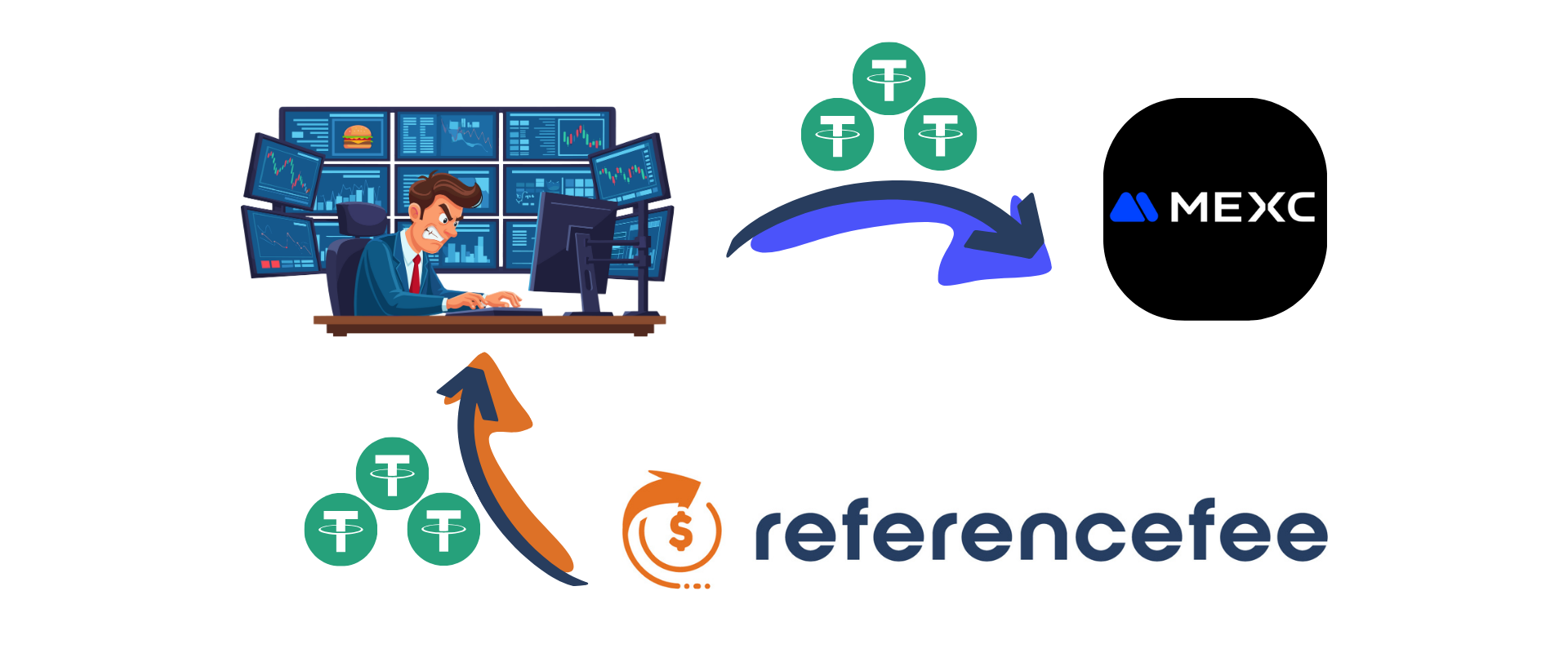
But did you know that you can get a significant portion of the commissions you pay on MEXC back as cash (USDT) and reduce your transaction costs to almost zero? In this comprehensive guide, we will take a deep dive into MEXC's commission structure and explain how you can turn these costs into automated income with Referencefee.
Part 1: How Does the MEXC Fee Structure Work?
Crypto exchanges deduct a certain cut from each transaction in exchange for the infrastructure and liquidity they provide. On MEXC, this system is based on the global standard "Maker" and "Taker" model. Understanding these terms is the first step in managing your costs.
Maker: If you enter a "Limit Order" to buy/sell a coin at a price lower or higher than the current price, your order is written to the order book and you wait. In this case, you provide liquidity to the exchange. Exchanges love liquidity, so Maker fees are generally much lower.
Taker: If you use a "Market Order" to buy or sell instantly from an order already available on the board, you consume liquidity from the market. Exchanges charge a higher rate for this.
If you need more fundamental information on why exchanges make these deductions and how order types reflect on your wallet, we strongly recommend checking out our detailed guide: What is a Trading Fee?
Part 2: The Hidden Danger: Leverage and Volume Trap
Many investors make the mistake of thinking: "Commission rates are already tiny numbers like 0.05%, how much can it add up to?"
This thought might be partially true in the spot market. However, in Futures and leverage trading, the math changes completely and turns against the investor. This is because exchanges calculate commissions not on your Initial Margin, but on your Position Size (Volume).
Let's Do the Math: Let's assume you have 1,000 USDT in your wallet and you open a Bitcoin position using 10x leverage.
Margin: 1,000 USDT
Position Size: 10,000 USDT (The exchange calculates the fee from here!)
Transaction: You pay a commission when opening the position. You pay commission again when closing the position.
If you are a "Scalper" doing 5-10 trades a day like this, or using an automated "Trading Bot," the situation gets worse. At the end of the month, 20%, or sometimes 40% of your gross profit goes solely to commissions. You think you are making a profit, but you are actually working for the exchange.
To understand how these "hidden costs" erode your portfolio in the long run, read our analytical article: Why Trading Fees Destroy Your Profits.
Part 3: The Solution: Cash Rebates with Referencefee
Did you know that institutional whales and large funds don't pay these full fees? They have special volume deals. For individual investors, the solution is Referencefee.
Referencefee is an investor-friendly optimization platform that adapts the "Cashback" logic to crypto trading fees.
How Does the System Work? The logic is simple and transparent:
You use a referral code when signing up for the exchange.
The exchange gives a portion of the trading fee you pay (e.g., 40%) to the referrer.
Referencefee does not keep this income; instead, it pays it back to you.
This way, by cutting out the middleman, you get back the majority of the commission you paid. This is not "free money"; it is your own money returning to you.
Why MEXC and Referencefee?
Automated and Daily Payout: No forms, no claims. Once registered, your rebates are calculated automatically every day and deposited into your exchange account the next morning.
Maximum Security (No-Wallet Policy): Referencefee does not request access to your wallet or API keys. It recognizes you only by your UID (User ID) on the exchange. Your funds are always in your control.
Part 4: Step-by-Step: How to Start MEXC Cashback?
It only takes 2 minutes to increase your ROI and stop the leak in your portfolio.
Create Account: Go to Referencefee.com and create a free account.
Select Exchange: Find MEXC on your Dashboard.
Register: Create a new registration on MEXC via the special "High-Rebate" link provided to you.
UID Match: Copy the UID number from your MEXC profile and paste it into the relevant box on the Referencefee panel.
That's it! Now, after every trade, the refund of the fee you paid will be automatically reflected in your account the next day.
Conclusion: Don't Leave Money on the Table
Trading is a game of math based on probabilities. You cannot know 100% where the market will go, but you can control 100% how much money leaves your pocket.
If you are an active trader, use bots, or scalp; not using Referencefee is equivalent to throwing money away every day. Combine MEXC's advantages with Referencefee's rebate power and start protecting your balance today.


